Beethoven's String Quartets
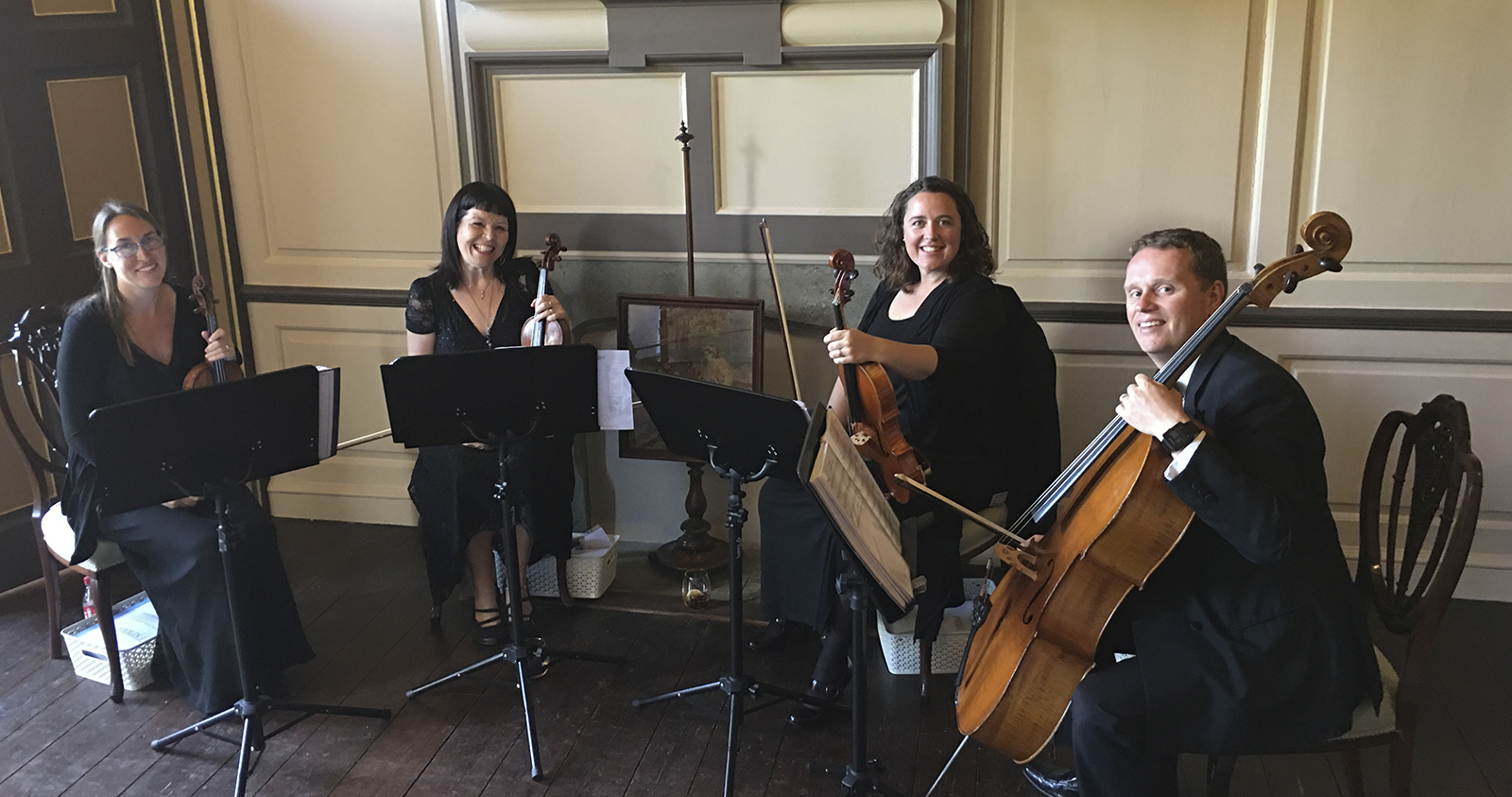
Beethoven's String Quartets: John Suchet's guide to the music
If Haydn is today called the ‘father’ of the String Quartet, and Mozart took the form to new heights, then Beethoven – characteristically – took hold of it and completely transformed it.
The five Late Quartets, written in the final years of his life, transcend anything he or anyone else had ever composed. Listening to the notes we see deep into the soul of this difficult, irascible man by now profoundly deaf. He has bared himself, exposed his emotions to us in a more profound way than words could ever express.
Early Quartets
He composed the 16 String Quartets in three fairly distinct blocks – nos. 1-6 when he was around 27-30 years of age, nos. 7-11 when he was 35-40, nos. 12-16 in the final three years of his life – leading to them being conveniently referred to in concert and on recordings as the Early, Middle and Late Quartets.
As with the Symphony, therefore, he came to the String Quartet comparatively late in life – hardly surprising given Haydn and Mozart’s earlier achievements. But when he began – again characteristically – he threw himself at it, producing a set of no fewer than six separate Quartets. We think of the Early Quartets as a huge achievement: he was not so impressed, at least not initially. He sent the first of the set to a friend, and then wrote to him:
Be sure not to pass on your quartet to anyone else, because I have substantially altered it. For only now have I learned to write quartets properly – as you will surely see when you receive them.
It is certain that he went on to revise fully at least one, possibly two or more of the remaining set. The completed versions are stunning, displaying a whole panoply of emotions. Do not make the mistake of considering these Early Quartets to be ‘lightweight’ Beethoven. There are light moments – the whole of no.3 (in fact the first to be composed) is lighter than the other five – but listen to the fourth movement of no.6. Beethoven named it La Malinconia [Melancholy]. We are in a dark world.
Middle Quartets
Forming the bulk of the Middle Quartets are the three Razumovskys, so called because they were commissioned by the Russian ambassador in Vienna, Count (later Prince) Razumovsky, himself an accomplished musician who played second violin in his own quartet. For his benefit Beethoven includes Russian themes in the first two of the set.
I find no.1 instantly accessible. The first movement begins with a wonderfully lively and memorable melody, and the second movement begins with a single note repeated so often on the cello that cellists of the day thought Beethoven was playing a joke on them and refused to play it!
The Harp and the Serioso
The other two of the Middle Quartets are nicknamed, respectively, the Harp and the Serioso, the first because of the plucked strings in the first movement, the second because Beethoven himself named it thus on the manuscript. The Harp is the lighter of the two, but no less characteristic of Beethoven for that. Its final movement is a theme and variations, a form much loved by Beethoven and one he usually reserved for the piano. The Serioso is indeed that, serious, a masterpiece in compression from the first bar onwards, and certainly a foretaste of what is to come in the final set of Quartets.
Late Quartets
The Late Quartets. The ultimate in Quartet writing, the ultimate in Beethoven. Aware that his life was running out, his deafness total, at odds with his nephew, drained physically and emotionally, his health alternating between bad and worse …
And five utter masterpieces. They have no names, they are simply opp. 127, 130, 131, 132, 135 (or, in order of composition, 127, 132, 130, 131, 135). Simply? In sheer scale, length, and complexity they stand alone. Countless books have been written about these Quartets. I will just draw your attention to a few details.
Listen to the third movement of op.132. Beethoven wrote at the top of the manuscript page: Heiliger Dankgesang eines Genesenen an die Gottheit, in der lydischen Tonart [Sacred Song of Thanksgiving from a Convalescent to the Deity, in the Lydian Mode].
The opening chords, played without vibrato, are like chords played on an organ. Beethoven tells us exactly what he has written (though not in the pictorial terms of thePastoral Symphony). In April 1825 he fell seriously ill with an abdominal complaint. His doctor – who had earlier been the target of his anger – refused to attend. The doctor who did come told him he was seriously ill and risked inflammation of the bowels which could prove fatal.
He put him on a strict diet, banning all wine, coffee, spirits, and spices of any kind, and warned Beethoven: I can promise you that if you drink any spirits, you will be lying weak and exhausted on your back within a few hours.
Beethoven went down to Baden when the weather warmed up, but wrote to the doctor that he was: still weak … belching, etc, … my catarrhal condition is as follows: I spit up rather a lot of blood, apparently only from the windpipe. But often it streams out of my nose, as happened frequently last winter as well. There is no doubt that my stomach has become terribly weak.
Beethoven recovered, but knew he had come close to death. That is what lies behind this extraordinary movement of op.132.
Op.130, the Cavatina
Even more remarkable, in my view, is the slow movement of Op.130, the Cavatina. It is utterly beautiful, even if you have no idea what is happening in Beethoven’s life. Over a gently pulsating rhythm from the three lower strings, the first violin sobs. In the fragmented notes there is anguish and despair.
Grosse Fuge
The original final movement of op.130 was the Grosse Fuge, a massive movement that is clearly too massive and unwieldy to sit at the end of the preceding five. Beethoven published it separately, and it remains a separate piece to this day (often performed by a string orchestra).
The Grosse Fuge is 21st century music. It is way ahead of its time. It is the marathon of the String Olympics. It exhausts the performers mentally and physically. It exhausts the listener. I once went to hear those great Beethoven players, The Lindsays, perform theGrosse Fuge at the Wigmore Hall in London. At the end, as they stood to take the applause, the first violinist Peter Cropper had to support himself on the chair; his face was a mask, his shirt soaking wet. As he walked off the stage, I thought he might fall.
If you are under the impression all Beethoven’s music is complicated, listen to the slow movement of the final String Quartet, op.135. Simply beautiful. Beautifully simple. The final movement of this String Quartet (composed to replace the Grosse Fuge) is the last complete piece of music Beethoven wrote. Over it Beethoven wrote: Must it be? It must be!
All manner of interpretations have been put on these enigmatic words, from the profound to the profoundly profound. All we know for sure is that when a certain official at the Imperial court, who was also a wealthy music lover, failed to attend the first performance of the op.130 Quartet, Beethoven insisted the man send Schuppanzigh the price of the subscription. The official wrote to Beethoven, asking Muss est sein? Beethoven sent him a humorous canon on the words Es muss sein. So there may be less to these words than meet the eye.